
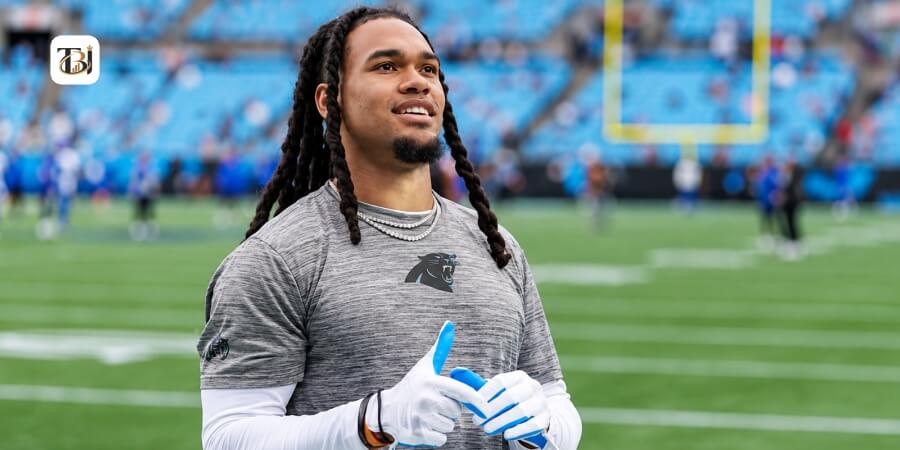
A running back’s value in the NFL is no longer measured only by how many yards he can gain between the tackles. The most useful backs can influence an offense before the snap, catch passes, protect the quarterback and create mismatches against linebackers. That broader role could become particularly important for jonathan brooks, whose path with the Carolina Panthers has been shaped by both promising talent and two major knee injuries.
Carolina selected jonathan brooks 46th overall in the 2024 NFL Draft after trading up to get him. At Texas, he had rushed for 1,139 yards and 10 touchdowns in his final season while adding 28 receptions for 335 yards and two receiving scores. His 6.1 yards per carry demonstrated his ability as a runner, but his receiving production also offered a glimpse of a player who could contribute in several phases of an offense.
The Skill Set That First Caught Carolina’s Attention
The Panthers did not draft jonathan brooks simply because they needed another ball carrier. His Texas tape showed patience, vision, balance and the ability to make defenders miss. NFL.com described him as a player with the potential to become a lead back, while his pre-draft evaluation also noted his low college workload relative to many prospects.
His receiving ability made the profile more interesting. During his final Texas season, Brooks averaged more than 12 yards per reception and produced a 73-yard reception against TCU. Texas also credited him with 14 plays of at least 20 yards that season, including 11 runs and three receptions. Those numbers suggest that his usefulness did not have to end when he was removed from the backfield.
That matters in Carolina because an offense can gain flexibility when the same personnel package can threaten defenses in several ways. A back who can line up behind the quarterback, release into the flat or run a route from the slot forces defenders to make decisions before the play develops.
Two ACL Injuries Have Changed the Timeline
The biggest obstacle in jonathan brooks‘ NFL development has not been a lack of ability. It has been availability. He tore his right ACL during his final Texas season, an injury that contributed to him being selected in the second round rather than earlier.
After reaching the NFL, Brooks appeared in only three games for Carolina in 2024, recording nine carries for 22 yards and three receptions for 23 yards. He then suffered another ACL injury during his rookie season and missed the entire 2025 campaign.
That history makes his return about more than simply regaining his old rushing form. Carolina has to manage how much work he receives, how he handles contact and whether his movement skills return consistently. For a player whose game relies heavily on footwork, balance and change of direction, the recovery process can affect several parts of his role at once.
A Different Kind of Backfield Opportunity
The 2026 season provides jonathan brooks with another opportunity to establish himself. The Panthers brought him back into the starting group during training camp, with head coach Dave Canales saying Brooks would work alongside Chuba Hubbard with the first team against Buffalo. Carolina’s own training-camp report said Brooks had looked strong throughout camp after missing the previous season.
The early regular-season numbers are still limited. Through two games, Brooks has nine carries for 30 yards and two catches for 43 yards. His 48-yard reception is already longer than any reception he recorded during his three-game rookie season, and his 21.5 yards per catch in 2026 highlights the possibility of using him as more than a conventional rushing option.
Those numbers are far too small to establish a season-long trend, but they do provide an interesting starting point. His receiving production gives Carolina another reason to keep him involved even on plays where he is not the primary rushing option.
The Value of Complementing Chuba Hubbard
The future of jonathan brooks does not necessarily have to involve immediately becoming Carolina’s unquestioned lead runner. A productive backfield can use multiple players with different strengths, particularly when one player is returning from significant injury.
Hubbard has already demonstrated that he can carry a substantial workload. When Brooks was drafted in 2024, Hubbard was coming off a 902-yard season on 238 carries. The Panthers therefore had an established option alongside their new second-round investment.
That creates an interesting possibility in 2026. Brooks could receive carefully managed rushing opportunities while contributing as a receiver, giving Carolina ways to use his athleticism without immediately asking him to handle a massive workload. Over time, his role could expand according to his health, efficiency and consistency.
What His Next Step Could Look Like
The development of jonathan brooks will likely depend on how well several parts of his game come together. His rushing efficiency needs to improve, his knee must continue to respond to NFL workloads, and his receiving skills need to become reliable enough for defenses to respect them.
His early 2026 receiving numbers offer one encouraging avenue. The Panthers’ official statistics show five career receptions through his first five NFL games, but 66 receiving yards, including the 48-yard catch this season. His rushing total remains only 52 yards across those games, underscoring how small his NFL sample still is.
For jonathan brooks, the most productive version of the future may therefore be broader than simply becoming Carolina’s leading rusher. His college career showed a player capable of running efficiently, catching the football and contributing in protection. His NFL career so far has been interrupted before he could fully demonstrate those traits.
If his health allows him to build continuity, jonathan brooks could become the kind of back who gives Carolina flexibility rather than simply additional rushing attempts. His ability to affect the passing game may prove just as important as his work between the tackles. For a Panthers offense looking for different ways to create space, that versatility could ultimately define what comes next for jonathan brooks.