
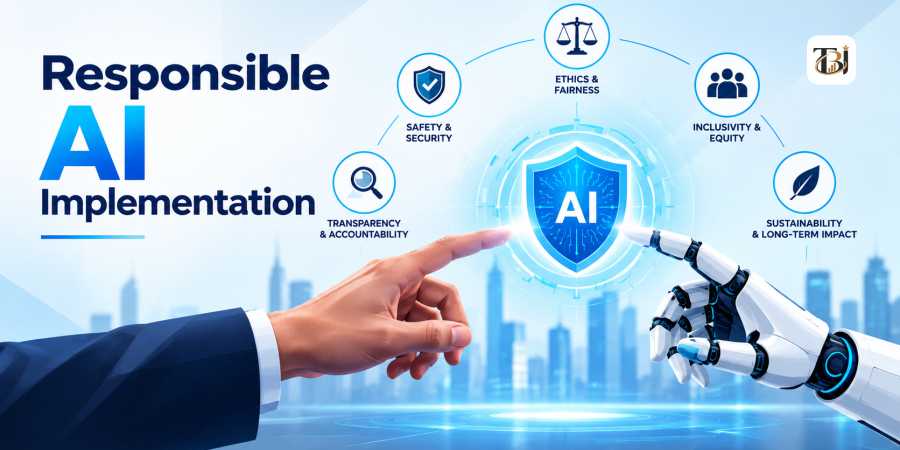
An AI system can perform impressively during testing and still make poor decisions after it enters everyday business operations. Customer behaviour changes, market conditions shift, data sources evolve, and the assumptions behind a model can become outdated. A system that once helped a bank flag suspicious transactions or helped a retailer forecast demand may gradually become less reliable without producing an obvious technical failure. That is why Responsible AI Implementation cannot end when a model is approved and deployed. It requires ongoing attention to how AI behaves, whose interests its decisions affect, and whether people can intervene when something goes wrong.
For businesses, the challenge is not simply to make AI more accurate. It is to understand when its performance changes, recognise the consequences of those changes, and establish clear accountability for decisions made with its assistance. The organisations most likely to gain lasting value from AI are those that treat monitoring, risk management, and human judgment as parts of the same operational process rather than separate compliance exercises.
Responsible AI Implementation Starts with Visibility into Decisions
Before an organisation can manage AI risks, it needs to know where AI is being used and what influence it has. This can be harder than it sounds. Different departments may adopt separate tools, employees may use external AI services without formal approval, and automated recommendations can become embedded in workflows before senior leaders understand their full impact.
IBM’s June 2026 research on enterprise AI found that 70% of surveyed technology leaders said business teams were deploying technology faster than IT could track. The study also found that two-thirds of surveyed CIOs and CTOs were accountable for AI systems they did not fully control.
These findings illustrate a practical problem: responsibility is difficult to exercise when visibility is incomplete.
Effective Responsible AI Implementation begins with an inventory of AI systems, including their intended purposes, data sources, business owners, and the decisions they influence. Companies should distinguish between a tool that drafts internal summaries and one that recommends credit limits, screens job applicants, or prioritises patients for care. Both require oversight, but the consequences of error are very different.
For each system, organisations should document what good performance looks like, what kinds of mistakes matter most, and who is authorised to respond when warning signs appear. This creates a clear starting point for monitoring rather than leaving teams to decide what matters after an incident occurs.
Monitoring AI Decisions Beyond Accuracy Scores
A model’s overall accuracy can conceal problems that affect particular customers, locations, or groups. A recruitment system, for example, might maintain a strong average ranking accuracy while consistently disadvantaging applicants whose career histories differ from the data used during training. A customer service model might resolve most routine requests successfully while giving misleading guidance in a specific language or for a particular product.
Businesses should therefore monitor AI through several measures at once. Depending on the application, these may include error rates, false positives, false negatives, processing delays, customer complaints, override frequency, and differences in outcomes across relevant groups. Where possible, results should be compared against a baseline established before deployment and broken down by meaningful segments rather than presented only as a single company-wide score.
Responsible AI Implementation also depends on keeping a record of how consequential decisions were reached. Logs should capture relevant inputs, model versions, outputs, and any human intervention, subject to privacy, security, and data-retention requirements. When a customer challenges a decision or an unusual pattern emerges, these records help investigators reconstruct what happened instead of relying on assumptions.
Not every unexpected result signals a failure. Some decisions are genuinely difficult, and changing conditions can alter the appropriate outcome. The purpose of monitoring is to identify patterns that deserve investigation, then determine whether they reflect normal variation, poor data quality, a technical defect, or a deeper problem with the model’s behaviour.
Detecting Model Drift Before It Becomes a Business Problem
Model drift occurs when the conditions surrounding an AI system change enough to weaken its performance or relevance. Data drift happens when incoming information differs from the data a model was trained on. Concept drift occurs when the relationship between inputs and the outcomes being predicted changes. A fraud detection model, for instance, may become less effective as criminals develop new transaction patterns, even if the software itself has not changed.
A sound Responsible AI Implementation strategy treats drift detection as a routine operational responsibility. Teams can compare incoming data with established baselines, track changes in prediction distributions, and measure performance against verified outcomes when those become available. Alerts should be calibrated to the risk of the application. A small shift in a product recommendation engine may warrant investigation, while a similar change in a medical or lending system may require immediate escalation.
Monitoring tools alone are not enough. A drift alert needs an owner, an investigation process, and a defined response. Depending on the cause, that response might involve checking a data pipeline, adjusting a decision threshold, retraining a model, returning temporarily to a previous version, or pausing automated decisions altogether. Retraining should never be treated as an automatic fix: if the new data contains historical bias or unreliable labels, a refreshed model can reproduce the same problems at greater scale.
Businesses should also test updated models before releasing them into live workflows. Comparing a proposed version with the existing system, using representative data and realistic scenarios, can reveal whether a change improves performance overall while creating new weaknesses for a particular group. This makes Responsible AI Implementation a continuous cycle of observation, investigation, testing, and controlled improvement.
Governance Should Fit the Risk, Not Just the Technology
No single monitoring framework will suit every AI application. A low-risk tool that summarises meeting notes does not need the same review process as a system that influences hiring, insurance, or access to financial services. Businesses should assess the possible harm, the scale of deployment, the sensitivity of the data, and how easily a decision can be reversed. This helps direct limited resources toward the systems where failure would matter most.
The National Institute of Standards and Technology’s AI Risk Management Framework offers a practical reference for identifying, assessing, and managing AI risks throughout a system’s lifecycle. Its guidance for generative AI expands on risks associated with these systems and provides organisations with a structured way to consider them.
Companies can use frameworks like these alongside their existing security, privacy, audit, and incident-management processes rather than creating disconnected governance structures.
For Responsible AI Implementation to work in practice, organisations should regularly review whether their controls remain effective. A monitoring dashboard may show that a model is performing within its technical thresholds, but customer complaints, staff feedback, or changing regulations may reveal issues those metrics miss. Periodic reviews should bring together technical teams, business owners, risk specialists, and the people who experience the system’s outcomes.
Finally, Responsible AI Implementation is not about eliminating every error or slowing innovation with endless approvals. It is about recognising that AI performance and business conditions can change, and ensuring the organisation is ready to respond. When businesses can trace decisions, detect drift early, and empower people to intervene, AI becomes easier to manage and more worthy of trust. The strongest measure of success is not how much autonomy a system gains, but whether the organisation can explain its impact, correct its mistakes, and remain accountable for the decisions it makes.