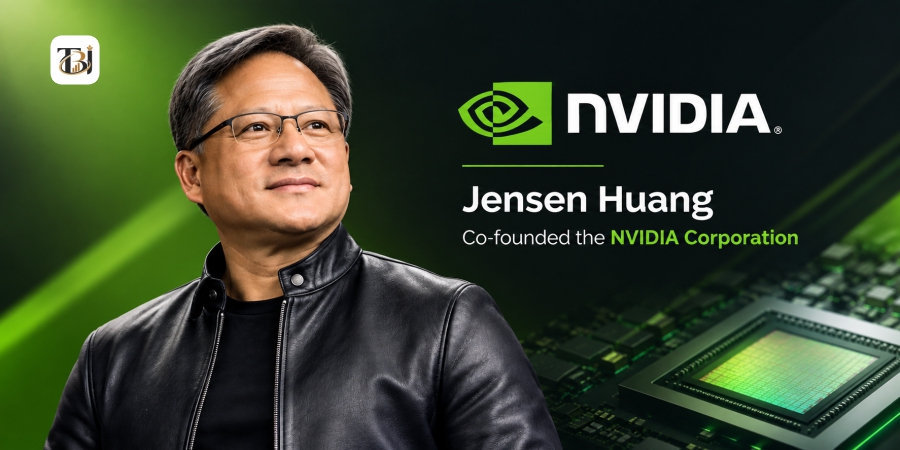
Artificial intelligence competition is increasingly becoming a competition over computing capacity. Models may attract the headlines, but behind every large training run, autonomous agent and AI application sits an enormous infrastructure stack of processors, networking systems, memory, software and data centers. At the center of that shift is Nvidia, and few executives are as closely associated with it as Jensen Huang. His role at the company has evolved from leading a graphics-chip business into directing one of the most important suppliers of the hardware infrastructure behind modern AI.
The scale of that transformation is visible in Nvidia’s financial results. The company reported fiscal 2026 revenue of $215.9 billion, up 65% year over year, with data-center computing revenue rising 59% as demand for its Blackwell platform accelerated. Data-center networking revenue grew even faster, increasing 142% as Nvidia expanded the high-speed connections needed to link large numbers of processors. Those figures help explain why Jensen Huang has become such a prominent figure in discussions about the global AI race.
Jensen Huang and the Shift from Chips to AI Infrastructure
Nvidia’s importance is no longer simply about producing powerful GPUs. The company increasingly sells complete computing systems designed to function as large-scale AI infrastructure. That distinction matters because modern AI workloads depend on thousands of processors working together rather than on an individual chip operating in isolation.
At GTC 2026, Jensen Huang presented this change through the idea of the “AI factory,” describing data centers as industrial infrastructure for generating intelligence. Nvidia’s strategy now combines GPUs, CPUs, networking, storage, software and optimized libraries into integrated platforms.
The company’s Vera Rubin platform illustrates the approach. Introduced in 2026, it combines multiple components, including the Rubin GPU, Vera CPU, NVLink networking, ConnectX networking technology, BlueField data-processing units and Spectrum Ethernet. Nvidia says the platform is designed to address everything from model training to inference and agentic AI workloads.
This is an important change in the economics of advanced computing. Customers are not simply buying processors. They are increasingly buying systems capable of moving enormous quantities of information between processors while keeping the entire workload operating efficiently.
The Vera Rubin Generation Raises the Stakes
Jensen Huang has also pushed Nvidia toward a faster product-development cycle. The company has been moving toward annual generations of AI computing platforms, with Blackwell followed by Rubin and then subsequent architectures planned on a regular cadence. That pace matters because AI developers are demanding more computation for both training and inference.
Nvidia said in March 2026 that Vera Rubin had entered full production with seven new chips intended to support large AI factories. By May, the company said its supply-chain ecosystem involved more than 350 factories across 30 countries, including 150 partners in Taiwan. Nvidia also reported that Vera Rubin could deliver ten times the agent throughput of the previous-generation Grace Blackwell platform at scale.
The significance extends beyond generative chatbots. Nvidia is positioning Rubin for agentic AI, scientific computing, robotics and other workloads where systems need to perform sequences of calculations rather than simply produce a single response.
In June, Nvidia said a Vera Rubin supercomputing system could provide more than seven exaflops of AI-for-science performance and up to five petaflops of native FP64 performance, with configurations supporting as many as 144 GPUs per rack. The company said systems based on the platform are planned for institutions including the Leibniz Supercomputing Centre, the U.S. National Energy Research Scientific Computing Center and Los Alamos National Laboratory.
Jensen Huang Faces a Competition That Is Bigger Than Nvidia
The global AI competition is not simply a contest between technology companies. Countries, cloud providers, semiconductor manufacturers, research institutions and AI laboratories are all trying to secure access to advanced computing.
The United States and China remain central to this competition, particularly because access to advanced chips has become intertwined with technology policy and national security. Recent Reuters reporting on China’s AI development highlights a different model of competition, with Beijing seeking to expand AI throughout its economy while Chinese companies contend with restrictions on access to advanced computing hardware.
That environment creates a complicated commercial situation for Nvidia. China is an important technology market, yet U.S. export restrictions have affected which advanced Nvidia products can be sold there. At the same time, Chinese companies are developing domestic alternatives and seeking greater control over their computing supply chains.
The issue is therefore not simply whether Nvidia can produce a faster processor. The larger question is how long its technology advantage can remain commercially significant when customers, governments and competitors are investing heavily in alternative hardware and AI architectures.
What Jensen Huang’s Role Means for the Next Phase
The significance of Jensen Huang in this story is less about being the face of a successful semiconductor company and more about how Nvidia has defined the infrastructure layer of the AI economy. His public presentations increasingly focus on the economics of inference, token generation, networking, power efficiency and large-scale computing rather than on GPUs as standalone products.
That shift is important because the next phase of AI could be increasingly dominated by inference. As AI agents move from answering questions to performing longer sequences of actions, the amount of computation required for each useful task can increase substantially. Nvidia is designing its platforms around that possibility, with Rubin combining processors, networking and software into systems intended to keep those workloads moving efficiently.
Still, Nvidia’s position should not be confused with ownership of the entire AI race. Competitors are developing alternative accelerators, cloud providers are designing custom chips, and governments are investing in domestic semiconductor capacity. Supply constraints also remain a challenge. Nvidia’s latest SEC filing notes that demand and production requirements are creating supply pressures as the company simultaneously ships Blackwell and Rubin systems.
Jensen Huang therefore sits at the intersection of several forces shaping advanced computing: rapidly increasing AI demand, semiconductor supply chains, software ecosystems, cloud infrastructure and international technology competition. Nvidia’s $215.9 billion fiscal 2026 revenue shows how dramatically that market has expanded, but the company’s next challenge is maintaining technological and ecosystem momentum while competitors and governments work to diversify the industry.
The story of Jensen Huang and Nvidia is ultimately a story about where AI power comes from. The most visible part of artificial intelligence may be the model on a screen, but the harder competition happens underneath it, inside enormous computing systems that require chips, networks, energy and software to operate together. As that infrastructure race accelerates, Jensen Huang’s Nvidia will remain one of the companies most closely watched for clues about how the next generation of advanced computing is taking shape.