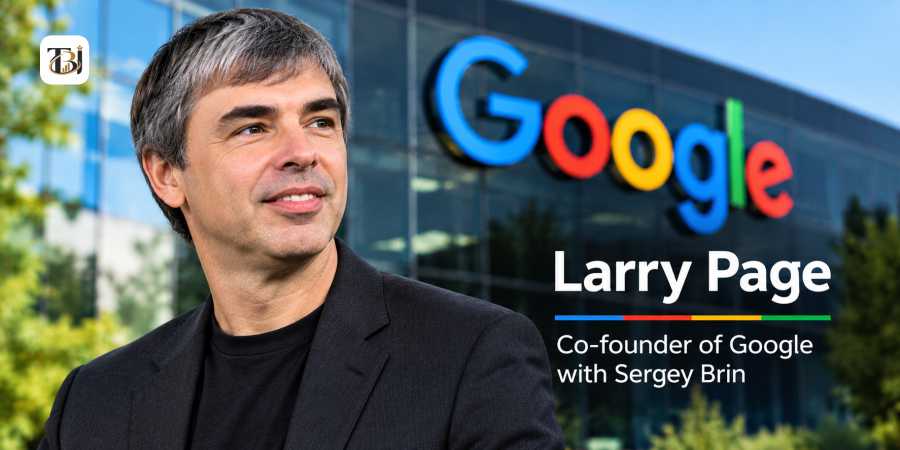
Some technology companies concentrate on improving what already works. Others are willing to spend years exploring ideas that may never become commercially viable. Google’s history reflects both approaches, but its most ambitious projects reveal a philosophy that Larry Page helped establish early in the company’s development: the belief that technology should address problems on a scale much larger than the next product release.
That philosophy has become increasingly relevant as Alphabet competes in artificial intelligence, autonomous transportation, cloud computing, and advanced scientific research. Page stepped down as Alphabet’s CEO in 2019, handing operational leadership to Sundar Pichai, but the organization he helped shape continues to pursue projects that extend beyond conventional internet services. The important question is no longer simply whether moonshot thinking can produce extraordinary inventions. It is whether Alphabet can turn those inventions into durable businesses while maintaining the financial discipline expected of a global technology company.
Larry Page and the Logic of Moonshot Thinking
Larry Page’s approach to innovation developed around a simple distinction between incremental improvement and fundamental change. Instead of asking how an existing product could become slightly better, he encouraged teams to consider whether a completely different technological approach could solve a much larger problem.
This thinking helped inspire the creation of Google X, now known as X, Alphabet’s moonshot innovation laboratory. Established around 2010, the organization was designed to explore technologies that initially appeared difficult, expensive, or impractical. Its approach combined ambitious goals with experiments intended to establish whether an idea could work outside the imagination of its creators.
In a 2013 interview with WIRED, Page discussed the importance of pursuing breakthroughs rather than limiting innovation to gradual improvements. The underlying argument was that established businesses could become so focused on their existing operations that they overlooked opportunities capable of transforming entire industries.
Larry Page’s influence is particularly visible in the philosophy of aiming for improvements on a much larger scale. X has described its moonshot model through three requirements: addressing a significant problem, proposing a radically different technological solution, and demonstrating at least a plausible path toward making that solution work. The objective is ambitious, but the process depends on testing assumptions rather than simply believing in a compelling vision.
From Experimental Ideas to Commercial Businesses
Alphabet’s history offers several examples of how moonshot projects can develop into businesses with practical applications. Waymo, the autonomous-driving company, began within Google’s self-driving car initiative before becoming a separate Alphabet business. Its evolution illustrates the long journey between demonstrating a technological possibility and operating a commercial service.
Waymo now provides fully autonomous, paid ride-hailing services in multiple cities. The company has moved beyond research demonstrations into a business that must manage passenger demand, fleet operations, safety, infrastructure, and expansion costs. Alphabet’s 2025 annual report identifies Waymo as one of its established Other Bets businesses, distinguishing it from the core Google Services and Google Cloud operations.
The financial commitment remains substantial. In October 2026, Reuters reported that Waymo secured a $5 billion term loan to support the expansion of its autonomous ride-hailing operations in the United States and internationally. The financing illustrates the capital required to scale technology that depends on sophisticated software, vehicles, operational infrastructure, and continued development.
This is where Larry Page’s long-term philosophy encounters the realities of business management. An invention can be technically impressive without becoming commercially sustainable. Successful expansion requires reliable operations, customer acceptance, regulatory compliance, and a credible path toward generating returns. Waymo’s progress demonstrates the potential of patient investment, while its capital requirements show why patience alone is not a business strategy.
Artificial Intelligence Changes the Scale of the Ambition
Artificial intelligence represents another important expression of Alphabet’s long-term technology strategy. Unlike autonomous vehicles, which require specialized physical infrastructure, AI can influence numerous existing products simultaneously. Search, productivity tools, cloud services, software development, and scientific research all offer opportunities for AI-driven improvements.
Alphabet’s early investment in AI research eventually became central to its main business. Its 2025 annual report notes that technologies once treated as ambitious research projects are now incorporated into core products and are important to future development. The company also identifies AI-assisted drug discovery through Isomorphic Labs and continued work in quantum computing as areas of long-term interest.
The financial scale of this transition is considerable. In its June 2026 investor presentation, Alphabet projected capital expenditure of $180 billion to $190 billion for the year, approximately twice its 2025 spending and around six times its 2022 level. The company said most of the investment would support technical infrastructure needed to serve growing demand for AI products and services.
For Larry Page, this kind of investment would fit the broader logic of pursuing technologies that can reshape markets rather than merely defend an existing position. However, the present AI race introduces a sharper competitive challenge. Alphabet must invest heavily while competing with Microsoft, OpenAI, Anthropic, and other companies developing powerful AI systems. It must also determine how new AI experiences affect its traditional advertising model, which remains central to its financial performance.
The Difficult Economics of Thinking Big
Moonshot projects can create valuable intellectual property and open entirely new markets, but they also carry the possibility of prolonged losses. Alphabet’s structure allows experimental businesses to develop outside the immediate demands of Google’s main operations. That separation can give unconventional ideas time to mature, although it does not eliminate the need for eventual commercial results.
The history of X makes this tension clear. Projects such as Loon, which explored delivering internet connectivity through high-altitude balloons, did not all become lasting businesses. Others, including Wing’s drone-delivery initiative, moved toward practical commercial applications. The mixed record illustrates that experimentation produces both valuable advances and ideas that cannot justify further investment.
Larry Page’s vision therefore raises a question that remains relevant to large technology companies: how much uncertainty should a successful business be willing to absorb in exchange for future opportunities? Alphabet has the financial resources to pursue long development cycles, but shareholders still need evidence that major investments can produce value.
What Larry Page’s Legacy Means for Alphabet’s Future
Page is no longer responsible for Alphabet’s daily management, and the company’s current direction reflects decisions made by Pichai and its wider leadership team. Still, the organizational foundations associated with Page remain visible in the company’s willingness to invest in technologies that extend beyond its original search business.
The next stage will depend on execution. AI must deliver useful products and sustainable revenue. Waymo must expand without allowing operational complexity and capital requirements to overwhelm its commercial prospects. Research ventures such as Isomorphic Labs must demonstrate that scientific advances can translate into meaningful applications. Each area presents a different challenge, despite sharing a preference for long-term technological ambition.
Larry Page’s lasting contribution may ultimately be less about any single invention than about the range of possibilities Alphabet considers worth pursuing. Moonshot thinking gives a company permission to question established assumptions, but it does not guarantee success. Its value emerges when bold ideas are paired with rigorous experiments, realistic economics, and the willingness to change direction.
Alphabet’s future will depend on balancing those forces. The company must continue exploring what technology might make possible while remaining accountable for what it actually delivers. That balance captures the enduring significance of Larry Page’s strategy: thinking beyond the immediate market is valuable, but turning that vision into something people use is what gives a moonshot its lasting worth.